Testimony submitted by Gregory J. Morris, Chief Executive Officer of New York City Employment & Training Coalition on April 15, 2026.
My name is Gregory J Morris. I serve as CEO of the New York City Employment and Training Coalition (NYCETC) – the country’s largest city-based workforce development association. NYCETC works to expand access to good jobs and better wages by helping build a stronger, more effective workforce system in NYC.
I appreciate the focus of today’s hearing because it highlights a fundamental misdiagnosis of the child care crisis.
This is not, at its core, a supply problem.
It is a workforce system failure—one that is constraining access, driving up costs, and undermining quality across the early childhood sector.
Let us ground that in the data.
New York City currently serves fewer than half of children under five in formal early care and education settings. At the same time, providers report persistent vacancy rates and staffing instability. Research from the New York Early Childhood Professional Development Institute finds that early childhood educators in New York City earn substantially less than their K–12 counterparts, despite comparable credential expectations. The consequence is predictable: turnover rates that often exceed 20 to 25 percent annually, disrupting continuity of care and increasing system costs.
Simultaneously, the city continues to experience labor-market dislocation—particularly among low-wage workers and those seeking entry into stable career pathways.
In economic terms, we observe a classic coordination failure: unmet labor demand coexisting with underutilized labor supply, mediated by fragmented institutions and weakly aligned incentives.
The legislation before the Council is therefore equally timely and necessary.
A structured pathway into the early childhood workforce—combining financial support, training, and a service commitment—reflects what the evidence base tells us about effective workforce interventions. However, its success will depend not only on program design, but also on the extent to which it is embedded within a coherent, citywide workforce strategy.
I would offer three areas for consideration.
1. The City must move from programmatic interventions to system-level workforce pathways.
At present, entry into the early childhood workforce is diffuse, uncoordinated, and often disconnected from formal education and training systems. This proposal creates an opportunity to formalize that pipeline—but only if it is intentionally aligned with institutions such as the City University of New York, labor partners, and community-based training providers.
Critically, the City already operates a large-scale workforce entry mechanism through the New York City Department of Youth and Community Development, most notably the Summer Youth Employment Program, which serves approximately 100,000 young people annually.
However, SYEP largely functions as a short-term employment intervention rather than a structured career pathway.
The opportunity here is to convert SYEP from a point-in-time experience into a sequenced pipeline placing participants in early childhood settings, connecting them to postsecondary credential programs, and supporting their progression into permanent roles. Evidence from sector-based training models suggests that when training is aligned with employer demand and includes work-based learning, placement rates can exceed 70 percent, with measurable gains in earnings over time.
This is the distinction between access and mobility.
2. Workforce stabilization must be treated as a precondition for system performance.
Much of the current policy conversation focuses on recruitment. The evidence suggests this is insufficient.
Retention is the binding constraint.
Early childhood educators in New York City face wage structures that aren’t competitive with adjacent sectors, including K–12 education and even entry-level service occupations. The result is persistent churn that imposes costs not only on providers but also on children and families, disrupting care environments.
Addressing this requires a combination of wage supports, credentialing pathways, and advancement opportunities—particularly for incumbent workers, many of whom are already performing core functions without formal recognition or compensation aligned to their responsibilities.
It also needs targeted investment in bilingual and culturally competent educators, who are essential in a city as diverse as New York.
Philanthropy has played an important, though necessarily limited, role in piloting and scaling elements of this work. Institutions such as the Robin Hood Foundation have demonstrated the impact of investments in coaching, wraparound supports, and sectoral strategies. However, these models achieve scale only when integrated into public systems and supported by sustained public funding.
From a policy perspective, staff retention should be understood not as a downstream outcome, but as a leading indicator of system quality.
3. Administrative and operational systems must be aligned to support workforce participation.
Even well-designed workforce pathways will underperform if the wider system remains unstable. Providers consistently report challenges related to delayed payments, fragmented contracting processes, and variable enrollment. These factors directly affect their ability to hire, retain, and invest in staff.
From an institutional standpoint, these are failures of system design rather than implementation. If reimbursement timelines are unpredictable, providers cannot offer stable wages. If enrollment systems are misaligned, staffing becomes responsive rather than strategic.
The legislation’s inclusion of child care supports for participants is important. But a complete approach requires modernizing contracting, improving payment systems, and greater coordination across administering agencies.
In short, workforce policy cannot be separated from administrative reform.
Stepping back, the early childhood workforce should be understood within the wider context of New York City’s labor market and economic development strategy.
Across sectors—including health care, infrastructure, and public service—we observe similar patterns: persistent vacancies, fragmented training systems, and underutilized talent.
This is why NYCETC has consistently advanced the position that workforce development constitutes core economic infrastructure.
It is the mechanism through which public investments translate into employment, wages, and mobility outcomes. It is also central to the City’s affordability agenda. Without access to stable, well-compensated employment, cost-of-living interventions alone are insufficient.
The significance of this moment lies in the degree of institutional alignment.
The Council, the Administration, higher education systems, providers, labor, and philanthropic actors are increasingly converging around a common understanding: that early childhood is essential infrastructure.
The question is whether we will build the workforce system required to sustain it.
The way forward is clear:
- Integrate SYEP and other entry points into structured career pathways.
- Align education, labor, and training systems around credentials and outcomes.
- Invest in wage growth and advancement to stabilize the workforce.
- And modernize administrative systems to support providers and workers alike.
If we do so, the returns are significant and measurable: increased labor force participation among parents, improved child outcomes, reduced turnover costs, and stronger long-term earnings trajectories for workers.
In that sense, this is not simply a sectoral intervention.
It amounts to a strategic investment in the City’s economic capacity.
Workforce development is not adjacent to child care policy—it is the enabling condition that makes universal child care feasible. Thank you.
Watch the hearing
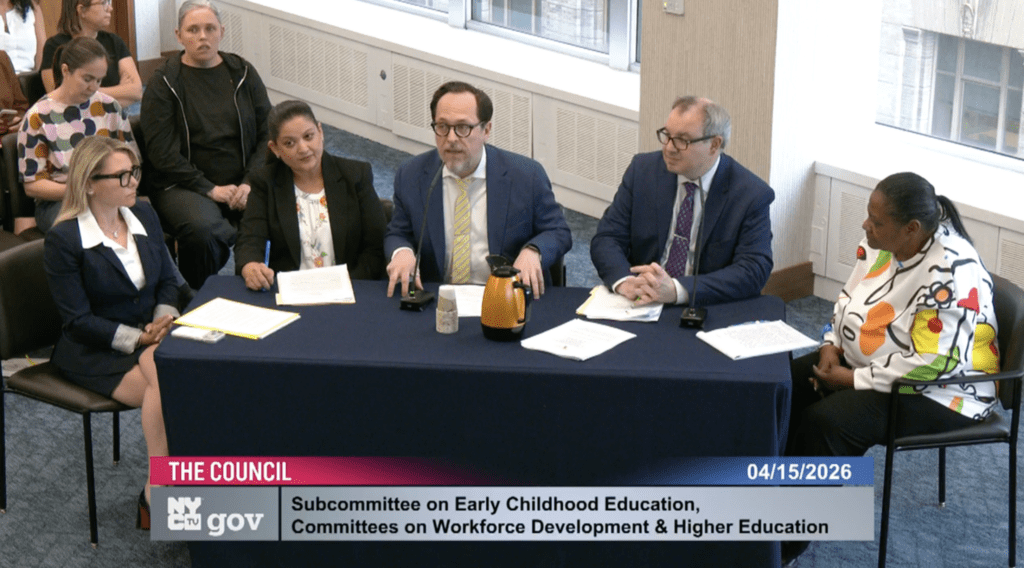
Watch Gregory J. Morris, Chief Executive Officer, NYCETC testify at the hearing on early childhood educator workforce development (starting at 2 hours and 57 minutes). Additionally, read our joint statement with the Day Care Council of New York.