Over 2,000 workers in New York City’s human services sector, including many NYCETC member organizations and allies, rallied outside City Hall last Thursday to urge Mayor Zohran Mamdani and the City Council to close the 30% pay gap between nonprofits who contract with the city and their city government counterparts.
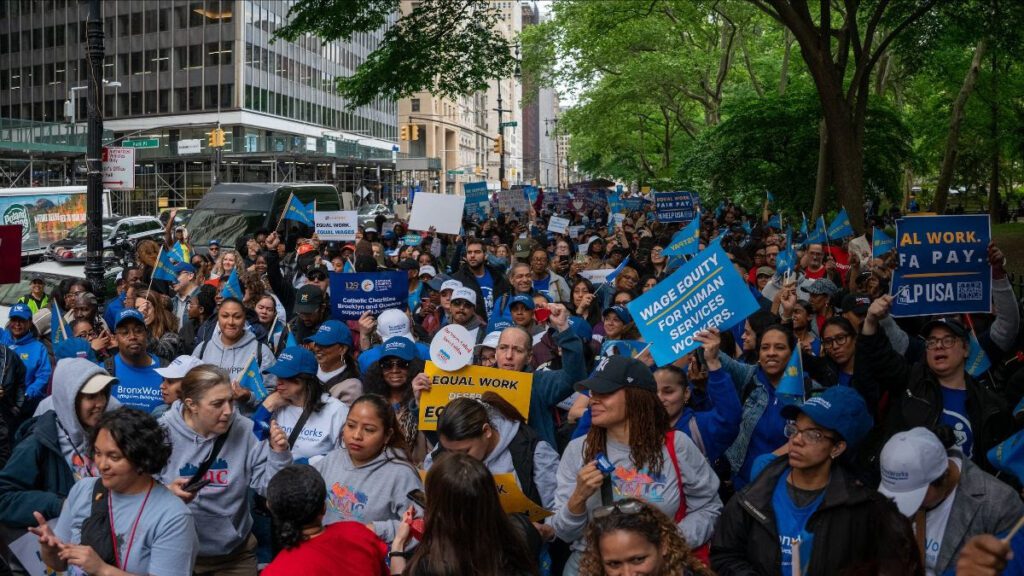
Organized by the Human Services Council (HSC), the rally marked the latest chapter of HSC’s #JustPay campaign, calling attention to the disparate treatment of human services workers, who provide essential services to New Yorkers — while often being underpaid, overworked, and struggling to make ends meet themselves.
“I hate it when they say, ‘Oh, you’re doing God’s work!’ Really?” said Maria Lizardo, the executive director of Northern Manhattan Improvement Corporation (NMIC), an NYCETC member. “But even God needs to get paid, to pay his bills.”
One of the #JustPay campaign’s major wins has been securing a 3% annual cost-of-living adjustment for city-contracted human services workers. The next stage is ensuring the passage of Int 0452, a City Council bill that would more permanently rectify the 30% pay gap by requiring the city to pay contracted human services workers the same wages as their city counterparts.
Nonprofit leaders say the vast pay disparity makes it challenging to attract and retain staff. Moreover, staff turnover affects the quality and continuity of services. In other words, a community member might be constantly getting a different case worker, or attorney, or child care provider.
Wayne Ho, the president and CEO of the Chinese-American Planning Council (CPC), explained how he often sees talented staffers leaving after two or three years, in order to take jobs with higher salaries and more robust benefits in city government. He understands it, but said the frequent turnover often results in human services nonprofits feeling like “a training ground for government agencies,” rather than a place for staffers to grow their careers.
In addition, when a staffer leaves for a higher-paying job in government or in the private sector, the organization has to quickly recruit and train a new person to fill that role, which takes time and resources away from providing services to community members. Ho, an NYCETC board member, added that the lack of consistency can also affect the level of funding that an organization gets from the city, perpetuating the cycle.
“A lot of these contracts are based on our performance,” he said. “So if we have vacancies, we’re serving fewer kids, we’re serving fewer families, we’re serving fewer adults. So that impacts our reimbursements from the city.”
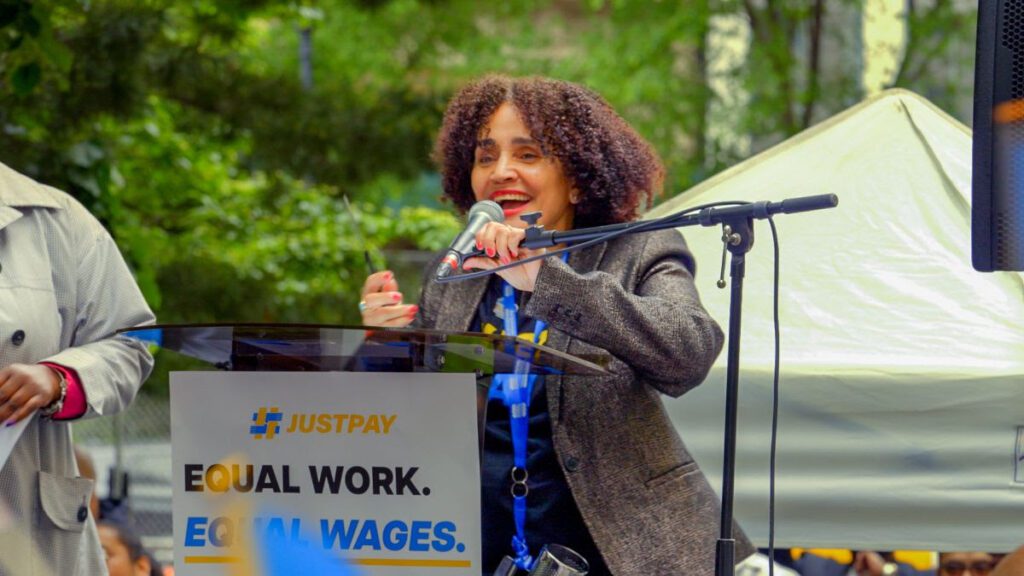
The pay disparity and inconsistent funding can make it difficult for human services organizations to create competitive wages across the board, as Lizardo explained.
“At NMIC, we do a lot of legal services. And we’ve really had to do a lot of somersaults and creative budgeting in order to attempt to develop a pay scale for attorneys,” she said. “And in order not to create this distance within our own organization and make sure that we’re being equitable, we’re also looking at pay parity for the rest of our staff, because it takes a whole organization to be strong and vibrant in order to be able to serve the community. And especially in this moment where there’s so much community need, and things are so complicated, we need to make sure that nonprofits are strong.”
Without strong organizations that are consistently staffed with workers who are being paid equitably, “families, children, and the community will suffer,” said Sharon Sewell-Fairman, president and CEO of Women Creating Change. “It’s really important that human services workers are not burnt out, they’re not struggling, they’re not in poverty while they’re helping to provide essential services.”
She pointed out that this isn’t just a labor issue. It’s also an issue of racial and gender equity, as women of color are perpetually and disproportionately underpaid.
“Asian women, they’re making 72 cents on the dollar, compared to a white male making $1. Black women are making 56 cents on the dollar, and Latina women are making 54 cents on the dollar,” she said, noting that women, and especially women of color, “tend to be concentrated in care work, which is undervalued.”
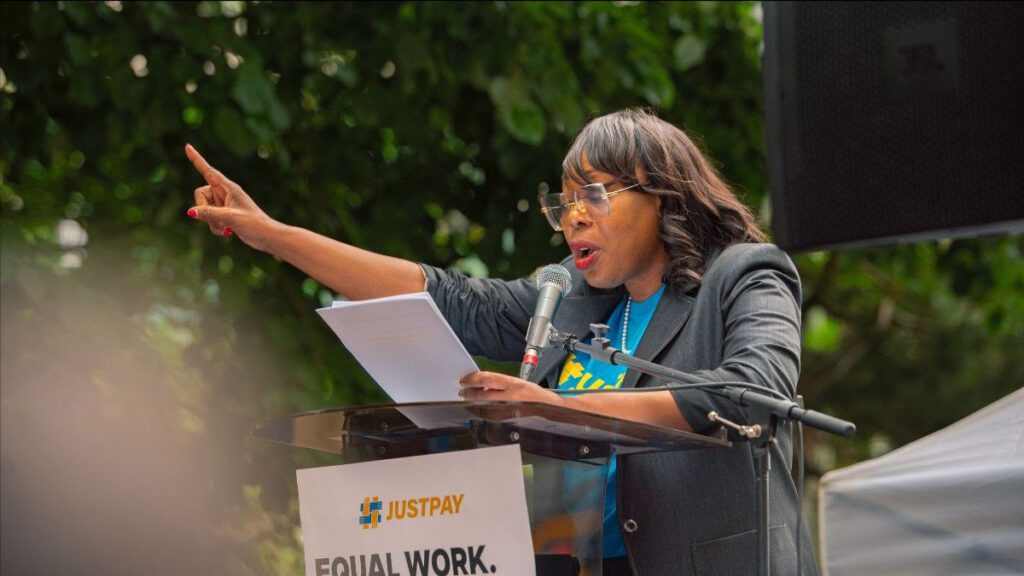
Someone inside City Hall who understands the stakes of this fight firsthand is Councilmember Althea Stevens, the lead sponsor of Int 0452.
“I worked in nonprofits for 20 years, running multiple programs and making less than I should have been. But I did the work because that’s what needed to be done, right? I kept the community services open as long as I could without being paid for it. Staff came in on the weekends because we knew that was the right thing to do, not because that’s what we wanted to do, but because we had to,” Stevens said. “So I know there are so many organizations [and] settlement houses that are doing real, quality work, and they can’t afford to pay their staff what they’re worth.”
As Mamdani attempts to enact his agenda to tackle the city’s affordability crisis, human services leaders say the time is especially ripe for him and the City Council to rectify the 30% pay gap. In fact, as HSC executive director Michelle Jackson noted, human services workers are crucial to delivering on that agenda.
“It’s human services workers and providers that make New York affordable for so many people,” Jackson said. “And if the mayor wants to make New York affordable, he has 80,000 workers that he pays under human services contracts. He can make New York affordable for them by giving them equal wages for equal work.”
More broadly, paying human services workers fairly is an issue that should be top of mind for all New Yorkers.
“Have you ever used child care services? Have you ever taken a class at a nonprofit? Has your kid learned to swim at one of the settlement houses?” Lizardo said. “If you have used any of these services, guess what? We have touched your lives, and we have made an impact on your lives. Now it’s time for you to show up for us, and demand just pay for our sector.”
To learn more and get involved:
- Subscribe to HSC’s updates on the #JustPay campaign
- If you’re an organization, add your name to the organizational sign-on
- To urge City Council to support Int 0452, HSC will launch an email action on June 3. Stay tuned for more details.