Testimony submitted by Gregory J. Morris, Chief Executive Officer of New York City Employment & Training Coalition on February 27, 2026.
Good afternoon, Chairs Won and Joseph,
My name is Gregory J. Morris, and I serve as CEO of the New York City Employment and Training Coalition, representing more than 220 organizations that connect New Yorkers to jobs, credentials, apprenticeships, and career pathways.
Alignment is not a slogan. It is a systems question. And right now, our systems are not fully aligned.
As we documented in Putting Our Dollars to Work, New York City makes significant public investments in workforce programming—but those investments are unevenly distributed and not consistently tied to measurable employment and wage outcomes. At the same time, research consistently shows that employment is the single most effective lever to reduce poverty, and that intensive, sector-based training increases long-term earnings. The evidence is clear. The question is whether our higher education and workforce systems are structured to act on that evidence together.
First, we must align funding with outcomes. CUNY, community-based providers, and workforce intermediaries should operate within a shared performance framework that tracks job placement, wage progression, and retention across programs. Today, no unified citywide system exists to measure these outcomes across providers. Without shared metrics, we cannot scale what works.
Second, we must align curriculum with employer demand. The labor market is evolving rapidly—particularly in healthcare, green infrastructure, technology, and the skilled trades. Employers report persistent talent shortages even as many New Yorkers remain disconnected from opportunity. Higher education institutions and workforce providers must co-design programs with industry—not in theory, but in structured partnership—with real-time labor market feedback loops.
Third, we must align supportive services with student success. We know from state and national evidence that childcare, transportation, housing stability, and income supports determine whether students complete training and persist in employment. Workforce alignment without wraparound supports is not alignment—it is aspiration.
Fourth, we must align economic development with talent pipelines. Major development projects supported by the City should be required to demonstrate how they connect to CUNY and community based workforce providers. Community hiring commitments must translate into measurable educational and employment pathways—not simply aspirational language.
Finally, we must elevate accountability. NYCETC has launched a Workforce Benchmarking Network to institutionalize common performance indicators across providers. More than 25 organizations and 100 workforce professionals are participating in this effort. We believe this effort can inform citywide policy, including stronger coordination between CUNY, the Workforce Development Board, and City agencies.
This moment requires more than program expansion. It requires structural coherence. Higher education and workforce development must function as one connected ecosystem—grounded in data, accountable for outcomes, responsive to employers, and centered on economic mobility.
If we get this right, we do more than align systems. We create durable pathways to family-sustaining wages and shared prosperity for New Yorkers.
Thank you, and I look forward to your questions.
Watch the hearing
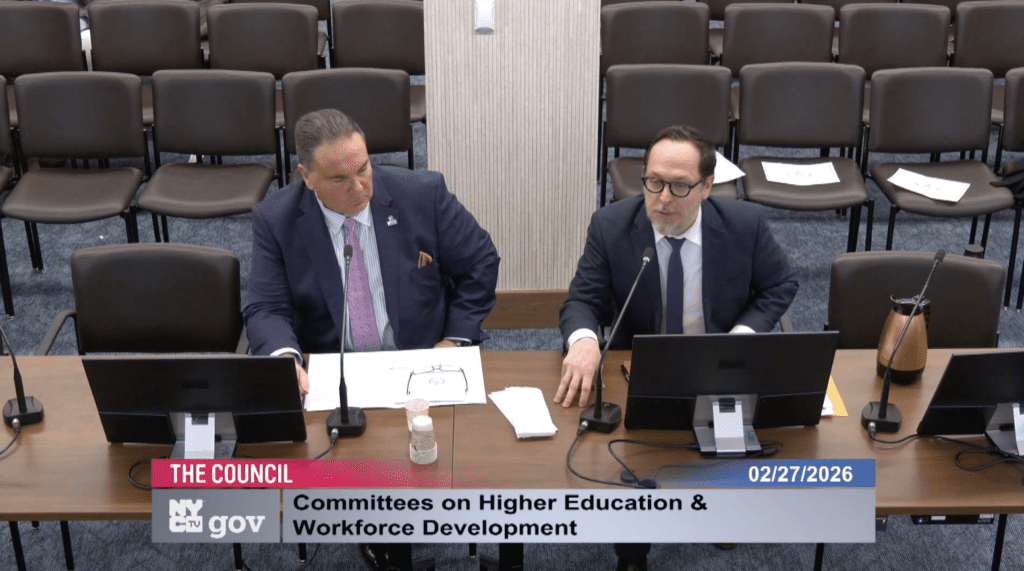
Gregory J. Morris, at 2 hours 46 minutes, delivered public testimony emphasizing the need for stronger system alignment to better connect New Yorkers to quality jobs. Read our recap of the hearing.